

You start every Monday with a fresh list and a sense of optimism. By Wednesday, that list has tripled in length, and by Friday, it’s a graveyard of half-finished thoughts and overdue reminders. If you’re a founder, this isn't just a personal failing—it’s a systemic one. Traditional, static to-do lists are fundamentally broken for the high-velocity world of entrepreneurship.
The problem isn’t your discipline; it’s your tools. Most productivity apps are just digital versions of paper lists: passive, context-blind, and ultimately, a source of more work. In this article, we’ll explore why these lists fail and how transitioning to an AI-driven operations partner can finally break the cycle of the productivity trap.
The Myth of the Static List
A traditional to-do list assumes a world that is linear. It assumes that a task added at 9:00 AM remains as important at 4:00 PM. But for a founder, context shifts every hour. An investor email can change your afternoon; a server crash can change your week.
When you use a static list, you are forced to pay what we call the operational tax. This is the hidden cognitive cost of manually sorting, prioritizing, and remembering what needs to be done. Every minute you spend moving a Trello card or re-typing a task in your planner is a minute you aren't spending on product strategy or team leadership.
Why traditional to-do lists fail for busy founders?
If to-do lists worked, founders would be the most relaxed people on earth. Instead, they are often the most overwhelmed. Here is the psychological and practical reality of why static lists fail:
1. The Decision Fatigue Trap
Every time you look at a list of 50 items, your brain has to perform a "micro-triage." You have to decide which one to do first. By the time you’ve picked a task, you’ve already burned through a portion of your executive function. For a founder making hundreds of high-stakes decisions a day, this "priority paralysis" is a silent killer of momentum.
2. The Zeigarnik Effect
Named after psychologist Bluma Zeigarnik, this phenomenon explains why our brains remember uncompleted tasks better than completed ones. A long to-do list is essentially a collection of "open loops" that keep your brain in a state of low-level anxiety. Without an intelligent system to close these loops or defer them with confidence, you experience constant mental "background noise."
3. Lack of Real-World Context
A list doesn't know you have a board meeting in two hours. It doesn't know that the person you need to email just replied to a different thread. Because the list is disconnected from your calendar and inbox, it requires you to be the bridge between information and action.
How can an AI operations partner solve the productivity trap of static lists?
The solution isn't a better list; it's a partner that understands your work. This is where SuperIntern changes the game. Instead of a passive bucket for tasks, an AI-driven system acts as a proactive filter.
Proactive Surfacing Over Manual Searching
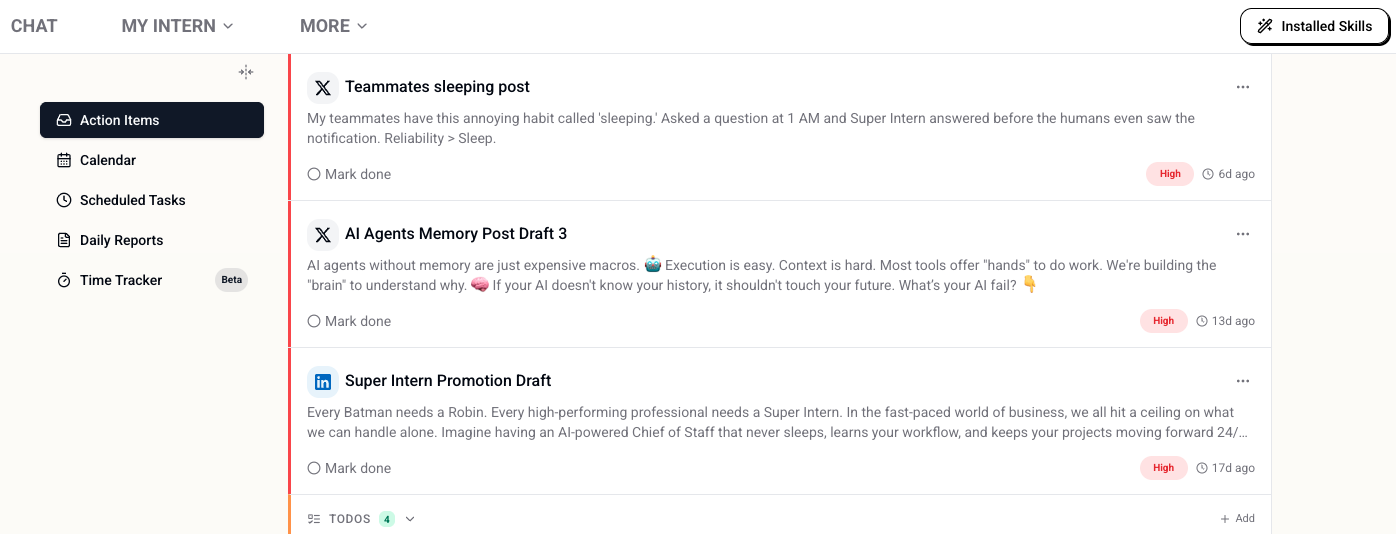
SuperIntern doesn't just wait for you to type a task. It "listens" to your meetings and "reads" your emails. If you tell a client, "I'll get that proposal to you by Thursday," SuperIntern recognizes the commitment and automatically creates an action item. It turns the "operational tax" into "operational dividends" by doing the capture work for you.
Dynamic Prioritization
By connecting to your calendar, SuperIntern understands the "white space" in your day. It doesn't just show you what needs to be done; it shows you what you can do right now. If you have a 30-minute gap between meetings, it can surface the quick follow-up emails that need your approval, rather than overwhelming you with a deep-work project you don't have time for.
Closing the Loop Automatically
The most powerful feature of an AI partner is the ability to not just track, but execute. SuperIntern can draft the replies, summarize the meetings, and prepare the briefs. When the "todo" is already 80% finished as a draft, the friction of starting disappears.
From "Doing Everything" to "Leading Everything"
The goal of a founder shouldn't be to get better at managing a to-do list. The goal should be to eliminate the need for one. When you offload the routine tracking and triage to an AI, you reclaim the mental bandwidth required for high-leverage work.
Stop being the "Chief Triage Officer" of your own inbox. Transition from a static list to a dynamic operations partner that scales with your ambition.
FAQ
Q: Why do traditional to-do lists fail for busy founders?
A: They fail because they are passive and lack context. Founders operate in a high-velocity environment where priorities shift rapidly. A static list creates "priority paralysis" and decision fatigue, forcing the founder to spend energy managing the list rather than executing the work.
Q: How can an AI operations partner solve the productivity trap of static lists?
A: An AI partner like SuperIntern solves this by proactively capturing tasks from meetings and emails, integrating them with your calendar, and drafting the work for you. It removes the "operational tax" of manual task management and ensures you only see the most relevant items at the right time.
Q: Is it safe to let an AI manage my tasks?
A: Yes, with the right permissions. SuperIntern only acts on the tools you connect and often provides drafts for your approval rather than taking irreversible actions on its own. You maintain final say while the AI handles the heavy lifting of organization.
Q: How do I get started with AI-driven task management?
A: You can start by connecting your primary work tools—calendar, email, and meeting platforms—to an AI intern. Start small by letting the AI summarize meetings and track action items, then gradually expand to automated follow-ups and content drafting.
Reclaim Your Focus with SuperIntern
The era of the manual to-do list is over. If you're ready to stop paying the operational tax and start leading with clarity, it's time to hire your AI intern. Sign up for SuperIntern today and experience what it feels like to have your tasks managed, not just listed.
Target Keywords: to-do list failure, founder productivity, AI prioritization, operational tax, task management for founders.


